
Moving Beyond the Prompt Box: How AI Agent Harnesses Turn Chat Advice into Real Work
From conversational advice to bounded execution: the tools, architectures, and economics of modern agent harnesses for engineering teams and small business operations.
Most people encounter large language models through a browser chat window. You type a prompt, wait a few seconds, read a paragraphs-long answer, and copy-paste the code or text somewhere else. For drafting an email or explaining an obscure shell error, that loop works fine.
If you run an engineering team, an independent consultancy, or a small business, you hit the walls of that setup almost immediately. The chat window has no hands. It cannot inspect your git history, query a local SQLite database, run a test suite, fix a typo that broke the build, or deploy your work. You end up acting as the human middleware: copying snippets into your editor, running the compiler, watching it fail, pasting the stack trace back into the chat, and hoping the model gets it right on the next attempt.
Breaking through that ceiling takes a change in architecture. Instead of treating the model as an advisory chatbot, you place it inside an agent harness: a structured runtime that provides a tool registry, an execution loop, persistent memory, strict operational guardrails, and the ability to learn. A harness gives the model a bounded working environment where it can run commands, inspect the output, and do real work.
1. What Is an Agent Harness?
In mechanical testing and software development, a test harness holds a component securely, feeds it inputs, measures the response, and keeps it within safe operating limits. An AI agent harness does the exact same thing for a language model.
At their core, language models do not take actions. They predict the next most likely token (not exactly but think of tokens as words). A harness wraps that raw predictive engine in four operational layers:
- A defined tool registry. This gives the model actual hands. Tools grant the runtime permission to read and write files, execute shell commands, query databases, call external APIs, and fetch web pages. Instead of writing prose describing how to fix a broken Python script, the model calls a tool to patch the file directly.
- The execution loop. This is the engine of agency: plan, act, observe, and adapt. The model issues a command, the harness executes it in the local environment, and the resulting standard output or error stream feeds right back into the model’s next prompt. When a test fails or a linter catches an issue, the model sees the failure and self-corrects without requiring human intervention.
- Persistent state and memory. A web chat session is ephemeral; close the browser tab and its memory vanishes. A proper harness stores state across sessions, preserving project architecture notes, coding standards, team conventions, and reusable procedural skills learned during previous runs.
- Guardrails and orchestration. Giving a machine model direct shell access without boundaries is reckless. The harness acts as a security policy engine: intercepting dangerous commands like recursive deletions, demanding operator confirmation before modifying protected files, running untrusted code in sandboxes, and managing child sub-agents assigned to focused subtasks.
Core Architectural Shift: Moving from prompting to a harness fundamentally reframes the interaction: you stop asking an assistant for advice and start delegating technical tasks to an operator working inside clear guardrails.
2. Architecture and Comparison: The Prompt-to-Harness Leap
To understand why agent harnesses outperform chat boxes, you have to look at where the operational weight sits. The diagram below illustrates the fundamental architectural contrast between traditional chat prompting and a harness-driven runtime.
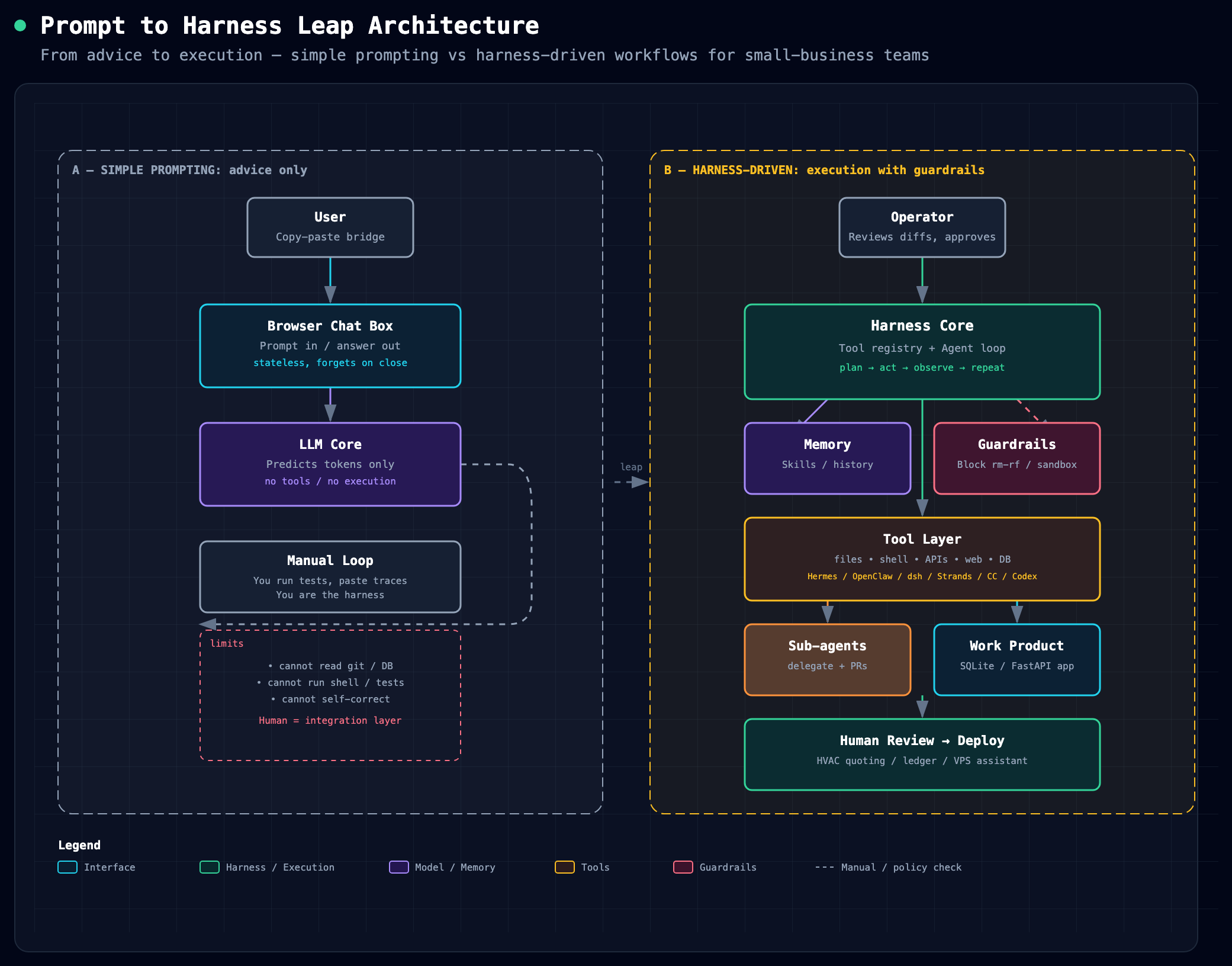 Figure 1: Architecture of the Prompt-to-Harness Leap — Contrasting stateless chatbot prompting with bounded, tool-augmented execution.
As shown in Figure 1, the contrast comes down to integration and execution:
- Side A (Simple Prompting): The operator is trapped in the middle as the manual loop. The LLM predicts tokens in isolation with no filesystem, shell, or database access. The human has to manually copy code, run test suites, interpret error traces, and paste them back. Furthermore, state evaporates the moment the browser tab is closed.
- Side B (Harness-Driven Execution): The harness runtime assumes the mechanical burden. An active agent loop executes commands, inspects live outputs, and iterates toward completion. Persistent memory retains skills and project conventions, while strict security guardrails prevent destructive actions. The human steps back to the proper role: operator and reviewer, inspecting diffs, validating outputs, and authorizing production changes.
The table below details how eight leading open-source and commercial harnesses implement these architectural layers, comparing execution locations, model compatibility, state management, and operational fit.
Harness Comparison Matrix
| Harness | License | Execution Runtime | Model Support | Memory & Persistence | Best Practical Fit |
|---|---|---|---|---|---|
| Hermes Agent | MIT (Open) | Local, VPS, Cloud | Agnostic (Gateway API, local GGUF/vLLM) | Active learning loop; procedural skills; cross-session search | Autonomous tasks, internal tooling, persistent local-first workflows |
| OpenClaw | MIT (Open) | Local Workstation | Agnostic (API or local models) | Session history; multi-channel chat persistence | Multi-channel chat ops (Telegram, Slack, Discord); local safety gates |
DeepSeek Harness (dsh) |
MIT (Open) | Local, Node.js Container | Agnostic (DeepSeek, Claude, OpenAI) | Modular plugin session logs | Modular developer pipelines; budget-conscious inference experimentation |
| AWS Strands | Apache 2.0 (Open) | Local, Cloud | Agnostic (via LiteLLM gateway) | Ephemeral session context | High-volume batch agent runs where per-task token cost dominates |
| Anthropic Claude Code | Commercial CLI | Local Terminal | Anthropic Claude models | Project context markdown (CLAUDE.md) |
Interactive, developer-in-the-loop engineering; rapid local debugging |
| OpenAI Codex | Commercial / Open CLI | Cloud Sandbox & Local CLI | OpenAI (codex-1, GPT-5 series) | Cloud session sandbox state | Asynchronous issue delegation; background test runs; automated PRs |
| Google Antigravity | Commercial | Cloud & Local CLI | Google Gemini models | Platform workspace state | Teams embedded in Google Cloud; multi-modal assets (UI mockups, videos) |
| Microsoft Agent Framework | Open / Azure | Azure Cloud & Local | OpenAI, Azure, Custom endpoints | Enterprise session state store | Regulated enterprise compliance; multi-agent graph workflows |
3. The Modern Tooling Ecosystem
Over the past eighteen months, agent tooling has split into two main philosophies: flexible open-source frameworks designed for local control and model independence, and commercial developer platforms engineered for turnkey velocity.
Open-Source Harnesses
Open-source harnesses prioritize operational sovereignty. You choose which models to run (local GGUF weights or hosted APIs), where data resides, and how security boundaries are enforced.
Hermes Agent (Nous Research)
- Website & Repository: GitHub Repository | Documentation
- License: MIT
Hermes Agent centers on persistent learning. Rather than treating an agent as a stateless utility, Hermes maintains an active learning loop. When it figures out how to solve a non-trivial deployment or configure an obscure tool, it authors a reusable procedural skill. In subsequent sessions, it searches its own history and reloads that skill, eliminating the repetitive onboarding typical of raw LLMs.
Architecturally, Hermes is model-agnostic. You can direct it to hosted frontier APIs or wire it straight to local models running on your own workstation through llama.cpp or vLLM. It ships with terminal interfaces, a desktop application, background cron scheduling, and multi-agent delegation tools capable of orchestrating subordinate workers.
- Strengths: Self-authoring skill loop and long-term memory; true model independence; runs on local silicon, VPS, or cloud; extensible tool and plugin ecosystem.
- Trade-offs: Rapid release cadence requires staying current with updates; mastering skill authoring requires an upfront investment.
OpenClaw
- Website & Repository: GitHub Repository | Project Site
- License: MIT
OpenClaw approaches agent workflows through existing communication channels. Instead of keeping the operator bound to a bash terminal, OpenClaw connects directly to messaging platforms you already use, including Telegram, Discord, WhatsApp, and Slack. It emphasizes a strict local-data privacy posture.
A standout architectural element is the OpenClaw Harness layer, an interception proxy that checks every proposed tool call against user-defined security policies prior to execution. If an autonomous model attempts an unsafe operation or requests a restricted directory, the harness halts the action and asks for authorization.
- Strengths: Broad chat app reach; strong local-first privacy; built-in security interception proxy.
- Trade-offs: Oriented toward personal and operational assistance rather than complex repository-scale refactoring; managing multi-file codebases is less natural than in a dedicated terminal harness.
DeepSeek Harness (dsh)
- Website & Repository: GitHub Repository | Project Site
- License: MIT
Launched in August 2026 alongside DeepSeek’s agentic reasoning models, dsh is built on the Node.js Cordis framework. Its design principle is radical modularity: the model connection, tool registry, session log, and agent loop itself are all swappable plugins.
It includes native providers that delegate tasks directly to CLI tools like Claude Code and OpenAI Codex, making it an effective orchestration layer for teams wanting to mix and match commercial backends while maintaining low-cost reasoning.
- Strengths: Clean, decoupled plugin architecture; lightweight deployment via npm; highly economical inference costs.
- Trade-offs: Currently a developer preview with explicit notices that breaking changes will occur; younger community ecosystem.
AWS Strands Harness
- Website & Repository: Announcement & Overview
- License: Apache 2.0
Released in September 2026 by the AWS Strands Agents team under the Apache 2.0 license, this general-purpose harness targets the financial friction of autonomous loops: token burn. By optimizing context management, prompt caching, and tool payload compression, AWS reports that Strands runs approximately 28% cheaper on token costs than alternative harnesses using the same underlying models, and averages 45% cheaper per task than Claude Code and Codex while maintaining comparable benchmark accuracy.
- Strengths: Engineered specifically for token efficiency in high-volume workloads; model-agnostic via LiteLLM; backed by enterprise infrastructure engineering.
- Trade-offs: Brand-new project with an early ecosystem; documentation currently focuses on synthetic benchmark numbers rather than day-to-day recipes.
Proprietary and Commercial Harnesses
Commercial harnesses offer tightly integrated, turnkey developer experiences backed by managed infrastructure and dedicated model optimizations.
Anthropic Claude Code
- Website: Product Page
- Access: Commercial CLI (requires Anthropic API access or Claude Pro/Team plan)
Claude Code is an interactive, terminal-native agent designed around developer pairing. It runs locally on your workstation, with direct access to your local files, git history, and build toolchain, while routing reasoning queries to Anthropic’s Claude models.
Rather than offering passive autocomplete suggestions, Claude Code navigates directory trees, writes and runs test suites, interprets compiler errors, and can drive headless browser sessions for interface testing. The interaction feels like working alongside an attentive junior engineer who presents diffs and asks for confirmation before executing sensitive commands.
- Strengths: Exceptional interactive coding fluency; excellent handling of large codebases; keeps source files local during execution.
- Trade-offs: Tied directly to Anthropic model endpoints; token consumption compounds quickly during long debugging sessions on large repositories.
OpenAI Codex
- Website: Product Page
- Access: Managed Cloud Service & Open-Source CLI
Where Claude Code focuses on interactive local pairing, OpenAI Codex is designed primarily for asynchronous, sandboxed delegation. In a typical workflow, you assign an issue or task to Codex, and the platform provisions an isolated cloud virtual environment, clones the target repository, completes the work, runs the tests, and opens a pull request for human review.
- Strengths: Ideal for asynchronous, hands-off background tasks; isolated cloud sandboxes eliminate risks to local workstations; clean GitHub integration.
- Trade-offs: Running repositories on cloud sandboxes requires compliance clearance for proprietary code; less responsive for immediate, exploratory debugging.
Google Antigravity
- Website: Product Page
- Access: Commercial platform & CLI (replaces Gemini CLI)
Google Antigravity combines an IDE extension, a headless CLI, and an agent-authoring environment. Connecting directly with Google Cloud and the Jules asynchronous coding agent, Antigravity emphasizes multi-modal engineering inputs—analyzing design mockups, architectural diagrams, and screen recordings alongside source code.
- Strengths: Unified visual and CLI interfaces; tight Google Cloud and Workspace integration; strong multi-modal analysis.
- Trade-offs: Frequent rebranding across Google’s developer stack; heavily oriented around Google Cloud ecosystems.
Microsoft Agent Framework and Copilot Studio
- Website: Agent Framework Docs | Copilot Studio Harnesses
- Access: Open-source library (
agent-frameworkon PyPI) with commercial Azure & Copilot Studio enterprise tiers
Microsoft Agent Framework merges AutoGen’s multi-agent patterns with the session state, type safety, and telemetry of Semantic Kernel. In Copilot Studio, Microsoft treats the harness as an enterprise administrative perimeter, enabling administrators to enforce compliance policies, audit logging, and data loss prevention around autonomous runs.
- Strengths: Robust enterprise governance, telemetry, and corporate compliance; supports complex graph-based multi-agent coordination.
- Trade-offs: Significant architectural complexity; heavy setup requirements that are impractical for small, agile teams.
4. Pragmatic Small-Business Use Cases
Online discussions around AI agents often get bogged down in trivial novelties: habit trackers, automated calendar color-coding, or generic email auto-responders. These toy demonstrations obscure the genuine economic utility of agent harnesses for small organizations.
A typical small business has deep domain knowledge but limited engineering bandwidth. Off-the-shelf software-as-a-service platforms charge $80 to $150 per seat each month, yet they routinely force the business to bend its real-world processes around rigid, generic templates. An agent harness shifts the economics of custom internal software development. A technically literate operator can direct a harness to author, test, and maintain dedicated tools through focused iterations.
Case 1: Custom Field-Service Quoting and Dispatch
A twelve-person commercial roofing and HVAC contractor uses complex estimation formulas that factor in material surcharges, roof pitch calculations, regional labor rates, and crane rental schedules. Commercial field-service software either cannot handle their proprietary pricing logic or requires tens of thousands of dollars in custom onboarding.
Using an interactive terminal harness like Claude Code or Hermes, the operations manager builds a lightweight internal web application tailored to their exact workflow:
- The harness inspects the directory, scaffolds an application using SQLite and FastAPI, and writes the calculation engine based on the company’s historical spreadsheets.
- When the manager notices that tax rules for commercial jobs in an adjacent county are missing, the harness updates the calculation function, creates unit tests to verify the fix across ten realistic scenarios, and runs the test suite.
- The manager inspects the git diff, verifies the numbers, and deploys the tool to a private server.
The business gets software matching its exact operational requirements without ongoing per-seat subscriptions or external consultants.
Case 2: Back-Office Document Extraction and Ledger Reconciliation
A three-person bookkeeping and tax advisory firm spends dozens of hours each month cross-referencing paper receipts, PDF subcontractor invoices, and CSV bank exports.
By deploying an agent harness equipped with filesystem, OCR, and API tools, the firm automates the mechanical extraction pass:
- The harness monitors an intake directory where staff drop scanned receipts and invoices.
- It extracts line items, matches totals against bank statement exports, and assigns preliminary expense categories based on documented client rules.
- When an invoice is illegible or a vendor is unrecognized, the harness writes the item to an exception report for human review rather than making an unverified guess.
- Verified records are compiled into structured files ready for direct import into the firm’s general ledger software.
The workflow eliminates repetitive data entry while preserving human review at every critical accounting decision.
Case 3: An Autonomous Technical Assistant for Solo Consultancies
An independent engineering or cybersecurity consultant balances client delivery with business development, monitoring, and administrative reporting. Running Hermes Agent on a local or virtual private server provides an operational assistant:
- The consultant establishes persistent skills containing their reporting templates, assessment checklists, and client-specific formatting guidelines.
- Scheduled background routines run overnight to query security advisories, check client infrastructure uptime, and assemble draft summaries for morning review.
- While traveling or on-site with a client, the consultant messages the harness through Telegram to pull up documentation, check system notes, or draft a follow-up summary.
The consultant retains complete control of deliverables, while the harness handles routine technical groundwork in the background.
5. Real Outcomes: Pragmatism Over Influencer Hype
Social media feeds are flooded with claims about solo founders building seven-figure software companies over a weekend with a single prompt. These stories distort expectations and distract from what actually works in production environments.
Grounded empirical research shows a clearer, more credible picture:
- McKinsey Workplace Studies: Workplace research indicates that software developers using generative AI tools complete routine subtasks roughly twice as fast. However, across entire project lifecycles, measured efficiency gains for high-performing engineering teams land in the 16% to 30% range.
- SecondTalent Industry Benchmarks: Independent engineering reviews from organizations like SecondTalent demonstrate that sustainable, long-term productivity gains for established technical teams typically settle between 10% and 20%.
- Menlo Ventures Enterprise Data: In a study surveying 495 enterprise decision-makers, Menlo Ventures reported that enterprise spending on vertical, domain-specific AI agents grew to $3.5 billion within a $37 billion enterprise generative AI market, led by adoption in healthcare ($1.5 billion) and legal operations ($650 million). The market momentum is moving decisively away from generic conversational bots and toward specialized agents embedded in operational workflows.
A 15% or 20% improvement in team output will not generate a viral headline, but in an operational setting, it is transformative. It means eliminating multi-month backlogs, fixing internal operational friction, and building specialized internal tools that previously could not justify custom engineering budgets.
6. Practical Guidelines for Getting Started
For teams looking to move beyond prompt experiments to harness-driven workflows, a measured progression works best:
- Start with an interactive terminal harness. Before attempting complex background swarms, spend time with a local tool like Claude Code or Hermes. Work through a contained project, such as refactoring a legacy utility script or writing integration tests for an existing codebase. Observe how the agent runs commands, inspects errors, and presents diffs for your review.
- Focus on a single, high-friction problem. Avoid attempting to automate an entire business in week one. Pick one repetitive operational task: generating weekly client summaries, reconciling messy vendor spreadsheets, or building a small internal tool for field staff.
- Establish strict operational boundaries. Never grant an autonomous agent unmonitored write access to production databases or unrestricted shell permissions. Use harnesses that prompt for confirmation before modifying files or executing system commands. Review proposed diffs with the same diligence you would apply to work from a junior technician.
- Preserve learned procedures. When an agent successfully solves a tricky operational problem, preserve the instructions, conventions, and edge cases. Store them in markdown files, repository configuration documents, or dedicated skill libraries. A harness becomes exponentially more capable as it accumulates clear documentation about how your organization works.
Conclusion: The browser prompt box was a helpful introduction to large language models. Moving your work into an agent harness is what turns that technology into enduring operational leverage.